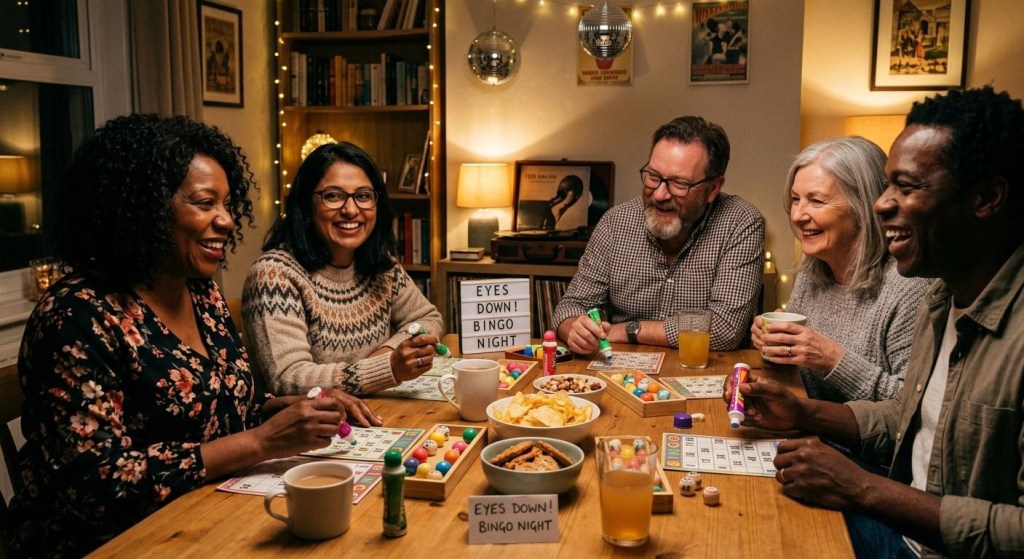
There’s something reassuringly unpolished about a proper bingo night. You don’t need a perfectly planned menu, matching tableware or a living room that looks like it belongs in a magazine. A few familiar faces, something decent to snack on, a bit of music and the gentle chaos of everyone talking over the numbers will do nicely.
That’s probably why bingo still fits so naturally into the modern night-in. We’ve become fond of entertainment that gives us a reason to gather without making the evening feel like a project. There are television watch-alongs, themed supper nights, nostalgic playlists and group chats that somehow generate 86 messages before anyone has even arrived. Bingo belongs in that same bracket: communal, flexible and not overly serious.
It gives the evening a shape, but leaves plenty of room for conversation. You can concentrate for a moment, then put the kettle on. Someone can miss a number because they’re halfway through an anecdote. Another person can insist they were “one away” three rounds running. It’s all part of it.
A familiar ritual with a fresh appeal
Bingo has a long place in British social life. The version many people recognise is 90-ball bingo, played with tickets arranged in three rows and nine columns. The caller’s opening “eyes down” remains one of those phrases that instantly creates a small sense of occasion.
Yet its appeal isn’t only about tradition. It works because it’s low-pressure entertainment. There’s no need for anyone to be the host with the most, the quiz expert or the person who knows every lyric from the 1980s. Everybody can settle in, follow along at their own pace and chat between calls.
That’s especially welcome when so much socialising can feel oddly performative. A night out may involve bookings, travel plans and deciding whether a particular outfit is too much or not enough. A bingo night at home is kinder than that. Put on something comfortable, bring a snack and arrive ready to laugh when somebody confidently marks the wrong number.
Many of us are looking for plans that feel sociable without being exhausting. The best nights in tend to have a shared focal point, but not one that demands total silence. Bingo gets that balance right.
Camp, music and a bit of theatrical nonsense
Classic games have always had a flair for presentation, and bingo is no exception. Number calls, silly catchphrases, bright colours, themed cards and the collective pause before a key number is announced all lend themselves to a little theatricality.
That’s why it sits so comfortably alongside contemporary pop culture. We’re used to entertainment being more than the thing itself. A television finale becomes a watch party. A song contest becomes an excuse for sequins and scorecards. A famous red-carpet moment becomes the subject of vigorous debate before the opening credits have even rolled.
Bingo has the same potential for shared ritual.
You can keep it traditional, with a caller and printed cards, or give the evening a theme that reflects whatever your group enjoys chatting about. Music works particularly well. Make a playlist of songs that get everyone singing along, then pause it when the calling begins. You could use decades as the loose theme, from Britpop to disco, and let each guest nominate one track.
Celebrity chatter is another easy starting point. The point isn’t to recreate a television programme or test anyone’s knowledge. It’s simply to create an atmosphere. A playful “awards night” dress code, mock acceptance speeches for the person who spills the dip, or a homemade “best entrance” certificate can make the room feel lively before the first card is even handed out.
The loveliest thing about camp presentation is that it lets everyone relax. Nobody has to pretend the snack table is a serious culinary achievement when the crisps are in bowls labelled “glamour” and “mystery flavour”.
The chat is the real main event
A bingo night may have numbers at its centre, but the conversation is usually what people remember. The card gives everyone something to look at when there’s a lull, while the pauses between calls invite the sort of side comments that make a group feel close.
There’s room for every type of guest:
- The person who takes marking their card with impressive care
- The one who keeps asking what number was just called
- The family member who knows an old phrase for almost every number
- The friend who turns up with biscuits “for the table”
- The guest who claims not to be competitive, then becomes suspiciously quiet near the end
It’s a format that works across generations of adults because the pace is easy to understand. You don’t need a long explanation or a specialist interest. If you’ve got a card, a marker and a caller, you’re ready.
Group chats can keep the feeling going as well. Before the evening, they’re useful for sorting food and deciding whether anyone is brave enough to commit to a theme. Afterwards, they’ll fill with photos of wonky paper hats, someone’s controversial playlist choices and repeated allegations that a particular caller was moving far too quickly.
Family connections matter here too. Some people grew up hearing bingo called at community events or remembering relatives saving their dabbers and tickets. Others have come to it through themed evenings with friends. Those experiences are different, but they share a simple pleasure: being in the same room, following the same game and having a proper laugh.
Ideas for an adult social evening
You don’t need to turn your home into a full-scale venue. In fact, keeping things simple is part of the charm. Choose one small idea, then let the people make the atmosphere.
Here are a few ways to make it feel special without overcomplicating things.
Pick a television-inspired theme
If your group has a favourite drama, talent show or Saturday-night format, use it as loose inspiration. Think sparkling outfits, dramatic announcements or snacks named after fictional categories. Keep it light and avoid trying to reproduce a show exactly. The fun comes from recognisable touches, not a flawless set design.
For entertainment inspiration, it can be worth checking your usual television, music and events coverage during the week. A major live broadcast, a reunion tour or an awards ceremony can provide a ready-made conversation starter.
Build a playlist with personality
Music changes the feel of a room in seconds. Ask each guest to add two or three songs before the night, then play them while people arrive and during breaks.
A few playlist approaches that tend to work:
- One-hit wonders and singalongs for instant recognition
- Songs from a single decade if your group loves nostalgia
- Movie and television themes for a more playful mood
- Guest picks only, which can produce some very revealing choices
Keep the volume low enough that nobody has to shout. The calling should be clear, although a little friendly confusion is almost inevitable.
Make snacks easy to share
Finger food suits bingo because people can pick at it between rounds. Crisps, sausage rolls, dips, mini sandwiches, fruit and a plate of biscuits are more than enough. If you’re doing a theme, give things silly labels on folded bits of paper. It costs nothing much and always gets noticed.
It also helps to have water, tea and other soft drinks within reach. Nobody wants to be hunting through cupboards just as the next round starts.
Give the dress code a gentle nudge
A dress code should feel like an invitation, never an obligation. “Something sparkly”, “favourite band T-shirt” or “dress like you’re attending an imaginary awards ceremony” gives people a prompt without making anyone feel awkward.
If costume themes aren’t your group’s thing, make it even simpler: slippers welcomed, pyjamas optional, no explanation required.
Keeping it enjoyable and responsible
For UK adults, a game-based night in is at its best when it remains a social activity rather than the focus of the whole evening. Agree the format beforehand, take breaks for food and conversation, and make sure nobody feels pressured to take part.
If gambling forms any part of the evening, it’s sensible to set clear personal limits and stick to them. It should never be treated as a way to make money or manage life’s expenses. Anyone worried about their own gambling, or somebody else’s, can seek confidential support from organisations such as GamCare or the National Gambling Helpline on 0808 8020 133.
The bigger point is that the warmth of bingo has never depended on a perfect card. It’s in the mock outrage, the snack crumbs, the questionable music choices and the moment everyone talks at once.
Online formats, in context
Some adults may prefer to take part remotely, perhaps when friends are spread across the country or a home gathering simply isn’t possible. It’s worth approaching any form of gambling as adult entertainment, with time and spending limits kept in mind. For adults looking at online options, browse Jackpotjoy’s bingo as part of the wider at-home entertainment landscape.
Author Profile

-
Deputy Editor
Features and account management. 7 years media experience. Previously covered features for online and print editions.
Email Adam@MarkMeets.com
Latest entries
 PostsWednesday, 7 October 2026, 10:43Planning Camera Movement Before Generating a Seedance 2.5 Video
 PostsWednesday, 7 October 2026, 10:42How Thematic Slots are Redefining Online Casino Gameplay
  PostsWednesday, 7 October 2026, 10:41Google Updates: A Practical Guide to Safer Link Building
 PostsTuesday, 6 October 2026, 19:36Why SD-WAN Solutions is the Foundation of Secure and High-Performance Enterprise Networks
Recent News, Photos, Videos, Reviews, Interviews And Opinions From MarkMeets.com
 Celebrity Game Nights You Can Recreate at Home
 The Ways that Bingo Halls Are Growing Popular Around the World
 Why Celebrities Are Bringing Game Nights Back Into the Spotlight
 Why Casino Bingo Games Are Popular in 2026
 How to Sleep Better: Essential Tips for Restful Nights
 Inside Powerball How America’s jackpot giant keeps players watching three nights a week
You must be logged in to post a comment.