Highest-Rated Movies on IMDb: Ratings, Votes and 35 Fan Favourites Explained
Searching for the highest-rated movies on IMDb can lead to prison dramas, gangster epics, superhero adventures and elaborate science fiction. Yet the numbers deserve careful reading. A film with the most votes is not necessarily the film with the highest score, and neither distinction automatically makes it the right choice for your next evening on the sofa.
This guide separates those measures, explains what IMDb actually publishes and revisits 35 popular films discussed in this feature. It is designed to help you discover something worth watching without pretending that a changing database provides a permanent verdict on cinema.
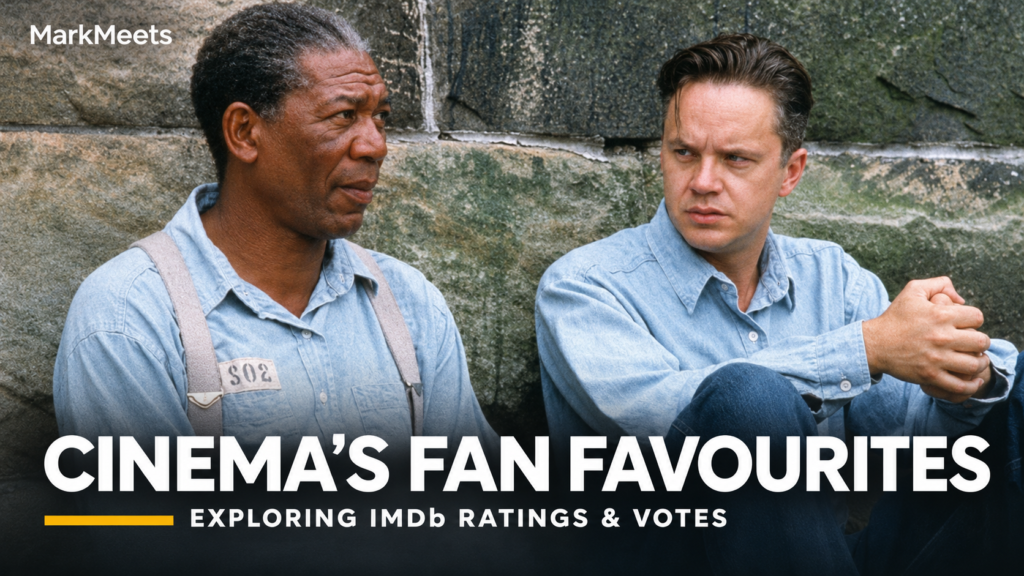
How to read this guide: The films below are arranged alphabetically, ignoring “The”, rather than presented as an unverified live ranking. The selection includes commercially successful films and audience favourites; it is not a claim that these are IMDb’s current 35 highest-rated or most-voted titles. Numerical scores and vote totals are deliberately omitted because they change.
Highest-Rated, Most-Voted and Most Popular: Three Different Questions
Movie lists often slide between three ideas: how highly people score a film, how many people have rated it and how much attention it is receiving. Those questions overlap, but they are not interchangeable.
The IMDb rating is a weighted score out of ten. The number of ratings records participation: how many users have submitted a score. A title attracting widespread attention can accumulate a large voting audience without matching the score of a smaller, more enthusiastically received film.
Consider two hypothetical examples. One film has a score of 8.8 from 200,000 ratings; another has 8.1 from two million. The first has the higher displayed rating. The second has ten times as many ratings. Calling either one the winner without naming the measure would conceal the actual comparison.
IMDb’s Top 250 is another specific product, with its own eligibility and regular-voter rules. Meanwhile, a list created by an individual IMDb member reflects that member’s selections. Its presence on the website does not make it an official IMDb ranking.
| Measure | What it shows | What it does not establish |
|---|---|---|
| IMDb user rating | A weighted audience score | Universal agreement about quality |
| Number of ratings | Participation by IMDb users | Ticket sales or total viewership |
| Top 250 position | Placement under that chart’s rules | A ranking of every screen production |
| Metascore | A separate critics’ score from Metacritic | The same measure as IMDb user voting |
How IMDb Calculates Its Ratings
IMDb states that it publishes weighted vote averages rather than simple arithmetic averages. In practical terms, not every submitted score necessarily has the same influence on the displayed result. The platform also describes safeguards intended to reduce attempts to manipulate ratings.
For the Top 250, IMDb uses ratings from people it identifies as regular voters. It does not disclose the complete criteria for identifying those voters. That limitation matters: readers should be cautious when another website claims to reproduce the entire current calculation precisely.
The platform says its weighted averages update numerous times each day. A screenshot, article or search result therefore represents information captured at a particular point, not a guaranteed live reading. Check IMDb’s explanation of weighted ratings and its ratings FAQ for the methodology it publicly describes.
For a trustworthy numerical countdown, a publisher needs a defined film category, a stated sorting method and a dated set of figures. Mixing figures collected at different times can produce an order that never actually existed. Rounding also creates apparent ties that cannot be resolved from the shortened numbers alone.
35 Popular Films to Explore Beyond the Numbers
These entries focus on the films themselves: their premises, performances and reasons to revisit them. They avoid major ending spoilers and make no claim to reproduce IMDb’s live chart. For another route into your watchlist, explore the movie trilogies ranked by MarkMeets readers.
The Avengers (2012)
Director: Joss Whedon. Bringing established Marvel heroes together requires more than arranging a shared battle. The film spends much of its running time showing why these personalities struggle to cooperate, using disagreement as the engine that makes their eventual teamwork satisfying.
Different abilities and comic rhythms help distinguish the ensemble. The resulting film can be enjoyed as an event, but its construction is also worth examining: introductions, alliances and changes of loyalty must remain clear while the scale grows. Readers following one particular hero can explore our Captain America screen guide.
Avengers: Endgame (2019)
Directors: Anthony Russo and Joe Russo. The appeal of Avengers: Endgame is inseparable from the relationships established across earlier Marvel films. Its characters are dealing with defeat before they can contemplate victory, giving the enormous production a surprisingly reflective foundation. Grief, responsibility and second chances matter alongside the spectacular confrontations.
It works best as the culmination of a journey rather than a completely self-contained introduction. On a return visit, the quieter exchanges often become as rewarding as the action. Readers comparing Marvel favourites can also explore our feature on Marvel movies and IMDb scores, remembering that published ratings represent a snapshot.
Avatar (2009)
Director: James Cameron. Pandora is the attraction here: an imagined environment given colour, movement and an elaborate biological identity. The narrative uses familiar adventure patterns, but the pleasure lies in discovering how its landscapes, creatures and communities fit together. Cameron invites viewers to experience the setting before the conflict forces them to reconsider its vulnerability.
Including Avatar also illustrates an essential distinction. Commercial scale, technological ambition and audience-rating position are different subjects. A film can be important to discussions about cinema without occupying the highest tier of every scoring system. Watch it for its visual storytelling, rather than expecting a number to explain its entire reputation.
Back to the Future (1985)
Director: Robert Zemeckis. Michael J. Fox and Christopher Lloyd give this time-travel adventure an instantly appealing rhythm. Marty McFly’s accidental trip into the past turns a speculative concept into a personal emergency: his future depends on understanding people he thought he already knew. Family embarrassment becomes unusually consequential.
The screenplay is particularly enjoyable on repeat viewing because seemingly casual details acquire new significance. Its comedy, invention and emotional clarity work together rather than competing for attention. You do not need an interest in theoretical time travel to appreciate a story that makes every small decision feel capable of changing everything.
Batman Begins (2005)
Director: Christopher Nolan. Before the familiar silhouette can mean anything, Bruce Wayne must decide what he wants it to represent. Batman Begins spends time on that uncertainty, following his training and return to a city whose institutions offer little reassurance. Fear becomes both an obstacle and a tool.
Christian Bale gives the character competing public and private identities, while the supporting cast helps make Gotham feel inhabited rather than decorative. The film’s strongest achievement is establishing a moral framework for the action. It asks what separates a symbol intended to protect people from an individual driven entirely by anger.
The Dark Knight (2008)
Director: Christopher Nolan. Batman’s campaign against organised crime collides with a threat determined to destabilise the rules themselves. Heath Ledger’s Joker creates uncertainty whenever he enters the story, while Christian Bale, Aaron Eckhart and Gary Oldman give the institutional struggle its human stakes.
The film’s action frequently turns on choices rather than physical strength alone. Characters are pressed to decide which principles survive an emergency, and who gets to make that decision for everyone else. For more on the genre surrounding Nolan’s Batman films, browse our selection of crime movies from the 2000s.
The Dark Knight Rises (2012)
Director: Christopher Nolan. The final instalment approaches Bruce Wayne as someone burdened by his earlier decisions. Returning to action means confronting physical limitations, damaged relationships and the question of whether Gotham still needs the same kind of protector. The film expands the conflict while repeatedly returning to the individual beneath the costume.
Its place in a trilogy is central to the experience. Images, conversations and character choices gain weight through connections with the preceding films. Viewers may disagree about its sprawling construction, but it offers plenty to discuss about sacrifice, inheritance and the difficulty of giving a long-running hero a conclusion.
The Departed (2006)
Director: Martin Scorsese. Two men occupy opposing sides of the same deception: one works undercover among criminals, while another serves criminal interests from inside the police. Leonardo DiCaprio and Matt Damon make their characters’ public identities feel increasingly difficult to sustain. Jack Nicholson adds another source of volatility.
The suspense develops from the possibility that an ordinary exchange might expose everything. Phones, meetings and apparently routine questions become threats. Although the narrative moves quickly, the psychological pressure remains clear. These are characters who cannot safely be themselves, even in the spaces that should provide protection from the lives they perform.
Django Unchained (2012)
Director: Quentin Tarantino. Jamie Foxx plays Django, a formerly enslaved man whose partnership with a bounty hunter becomes part of a mission to rescue his wife. The film draws on western traditions while confronting the brutality of American slavery through Tarantino’s confrontational, highly stylised approach.
Foxx provides the determined centre, with Christoph Waltz, Kerry Washington, Leonardo DiCaprio and Samuel L. Jackson contributing sharply contrasting performances. Dialogue can be as threatening as the gunplay. The graphic violence and tonal shifts deserve consideration when choosing it for a group, particularly if viewers expect a conventional historical drama.
Fight Club (1999)
Director: David Fincher. Edward Norton’s dissatisfied narrator meets Brad Pitt’s Tyler Durden, and a private source of release grows into something considerably more dangerous. The film is interested in consumption, alienation and the appeal of belonging, especially when belonging comes with destructive instructions.
Its imagery and memorable exchanges can be mistaken for an uncomplicated endorsement of its characters. A closer watch reveals a more uncomfortable relationship with their desires and behaviour. Return visits offer opportunities to examine the narration, visual clues and developing power dynamics. The experience benefits from knowing as little as possible about its major revelations beforehand.
Forrest Gump (1994)
Director: Robert Zemeckis. Tom Hanks anchors a story that moves through several decades of American life without losing sight of a small group of personal relationships. Historical events provide the changing backdrop, but affection, separation and loyalty supply the emotional continuity.
The film shifts confidently between broad comedy and sadness, asking its central performance to keep those movements coherent. Some viewers respond most strongly to its sentiment, while others find its treatment of history worth debating. Either way, its combination of an intimate voice and an expansive canvas gives audiences more to discuss than a single rating can capture.
Gladiator (2000)
Director: Ridley Scott. Russell Crowe’s Maximus is stripped of power and forced into a new public role, while Rome’s leadership turns spectacle into a means of control. The arena sequences have considerable force because the film establishes what its protagonist has lost before asking him to fight.
Joaquin Phoenix offers a contrasting portrait of authority built on insecurity and entitlement. Their conflict is personal, but the crowds and political manoeuvring give it a wider context. The result combines the immediacy of an action film with questions about reputation, loyalty and the kind of leadership people choose to applaud.
The Godfather (1972)
Director: Francis Ford Coppola. The Corleone family’s domestic relationships and criminal power are woven so closely together that separating them becomes impossible. Marlon Brando establishes the patriarch’s authority, while Al Pacino’s Michael gradually becomes the figure through whom the film examines inheritance and choice.
Its deliberate pace gives conversations and gestures unusual significance. A family gathering can communicate a hierarchy; an apparently practical decision can reshape someone’s future. The film’s reputation does not depend simply on quotable dialogue or famous confrontations. It rests on the patient accumulation of choices that make loyalty increasingly difficult to distinguish from submission.
The Godfather Part II (1974)
Director: Francis Ford Coppola. Parallel narratives follow the younger Vito Corleone and the established Michael. Robert De Niro and Al Pacino embody different stages of the family’s development, allowing the film to compare the building of power with its preservation.
The structure makes the sequel a conversation with its predecessor rather than a straightforward continuation. Prosperity and security are repeatedly measured against the relationships damaged in their pursuit. Watching the films together reveals how a family’s explanation of its own conduct can change while its appetite for control remains. It rewards attention to the contrast between public assurances and private consequences.
The Green Mile (1999)
Director: Frank Darabont. A death-row prison becomes the setting for a drama combining institutional routine with extraordinary events. Tom Hanks and Michael Clarke Duncan give its central relationship a mixture of curiosity, concern and vulnerability. The supernatural elements arrive within a world already shaped by punishment and unequal power.
The film asks viewers to consider what happens when official procedures cannot accommodate what individuals believe they understand. Its emotional approach is direct, and its treatment of suffering can be difficult to watch. Those qualities make it a different viewing proposition from a conventional prison thriller, despite the shared setting.
Inception (2010)
Director: Christopher Nolan. A team using shared-dream technology attempts an assignment built around planting an idea. The elaborate rules create opportunities for visual invention, but the mission’s greatest instability comes from the unresolved personal history of Leonardo DiCaprio’s character.
Different layers of action must remain legible while moving at different speeds, giving the editing and music an important organising role. A first viewing can be about following the operation; later viewings allow more attention to its emotional logic. The film works especially well for audiences who enjoy discussing how a story’s structure influences their understanding of its characters.
Inglourious Basterds (2009)
Director: Quentin Tarantino. Several plans converge in Nazi-occupied France, creating a film where a conversation may be more dangerous than a chase. Christoph Waltz’s performance depends on the uncertainty behind polished manners, while the multilingual exchanges make comprehension itself a source of tension.
The film is a deliberately revisionist work, not a documentary account of wartime events. Its interest lies in cinema, revenge and the power to reshape a story. Extended scenes reward attention to who controls an encounter and who merely appears to. When that balance changes, the consequences can arrive with startling speed.
Interstellar (2014)
Director: Christopher Nolan. Humanity’s uncertain future provides the scale, while a father’s separation from his children provides the ache. Matthew McConaughey gives the space mission an emotional centre that remains understandable even when the film moves into complex scientific ideas.
Time is experienced as a personal cost rather than simply a technical concept. The landscapes, spacecraft and sound design contribute to the spectacle, but the most affecting scenes often concern communication across distance. Viewers interested in science fiction that combines expansive imagery with family drama will find a particularly substantial example here.
Joker (2019)
Director: Todd Phillips. Joaquin Phoenix’s Arthur Fleck inhabits a city marked by inequality, indifference and instability. The film approaches a familiar comic-book identity through an individual character study, concentrating on humiliation, performance and the search for recognition.
Its unsettling tone makes it worth discussing beyond the question of whether someone enjoyed it. The relationship between explanation and justification remains particularly important: depicting a character’s circumstances does not settle how viewers should judge his actions. Phoenix’s physical performance and the film’s close perspective make those questions difficult to avoid, even when the wider story remains deliberately uncomfortable.
The Lord of the Rings: The Fellowship of the Ring (2001)
Director: Peter Jackson. The journey begins with the familiar comforts of the Shire before expanding into a world of competing histories and dangers. Its gradual movement gives viewers time to understand what is at stake emotionally before the scale becomes overwhelming.
The Fellowship’s members bring different motives, fears and abilities, turning an epic task into a negotiation between individuals. Performances, production design and Howard Shore’s music help establish places that feel distinct. For many viewers, the film’s particular pleasure lies in the sensation of setting out: the promise of discovery balanced against uncertainty about the road ahead.
The Lord of the Rings: The Return of the King (2003)
Director: Peter Jackson. Military conflict and the effort to destroy the Ring reach their final stages, but the emotional emphasis remains on endurance. Characters can influence events without possessing the strength, authority or certainty usually associated with cinematic heroes.
The film depends heavily on the relationships developed across the trilogy. Its quieter moments of loyalty give meaning to the immense battles surrounding them. When comparing versions, remember that theatrical and extended editions offer different running times and pacing. Neither should be described using the other’s length, a small detail that can otherwise confuse a viewing guide.
The Lord of the Rings: The Two Towers (2002)
Director: Peter Jackson. With the Fellowship divided, the narrative follows characters pursuing different routes through the same widening conflict. The challenge is maintaining momentum without providing a final resolution, and the film answers through sharply defined local stakes.
Gollum introduces a particularly uneasy form of companionship, while the defence of Helm’s Deep gives another strand a clear dramatic focus. The different settings allow contrasts between vulnerability, political hesitation and practical courage. Viewed within the trilogy, the film shows how a middle chapter can deepen an adventure by making its original task feel more difficult rather than merely larger.
The Matrix (1999)
Directors: Lana Wachowski and Lilly Wachowski. Keanu Reeves plays a man whose suspicions about ordinary life lead to an extraordinary discovery. The film combines cyberpunk, martial arts and philosophical questions within an unusually accessible framework of pursuit, initiation and choice.
Its costumes and visual effects became familiar cultural references, but the original film still has the advantage of revealing its world in carefully controlled stages. Knowledge changes the meaning of earlier images. That makes it rewarding both as an introductory adventure and as a film to revisit when considering how explanation, uncertainty and action can support one another.
Memento (2000)
Director: Christopher Nolan. Guy Pearce’s Leonard relies on notes, photographs and tattoos while investigating a deeply personal crime. His difficulty forming new memories turns seemingly basic acts of judgement into risks. Information can be available without being trustworthy.
The unusual chronology gives the audience an experience related to Leonard’s own limitations. Rather than simply observing his confusion, viewers must repeatedly reconstruct their understanding. Its central questions concern evidence, motivation and the stories people choose to preserve. It is a strong option for anyone who enjoys a mystery that makes the act of interpreting events part of the suspense.
The Prestige (2006)
Director: Christopher Nolan. Rival magicians played by Christian Bale and Hugh Jackman pursue professional supremacy at an increasing personal cost. Their competition links invention with secrecy, asking how much an audience wants to understand the trick behind an impressive performance.
The film’s own arrangement invites close examination. Details that appear incidental can become meaningful when viewed again, while the characters’ explanations rarely account for everything they do. Beneath the intricate construction lies a relatively direct concern: ambition can become an identity so consuming that ordinary relationships and satisfactions no longer seem sufficient.
Pulp Fiction (1994)
Director: Quentin Tarantino. Hitmen, a boxer, a crime boss and a pair of would-be robbers occupy intersecting stories in Los Angeles. John Travolta, Samuel L. Jackson, Uma Thurman and Bruce Willis contribute performances whose different rhythms help keep the shifting narrative coherent.
Its appeal comes partly from the collision between ordinary conversation and extraordinary danger. The chronology also changes the audience’s relationship with consequence, allowing a character to return after an apparent narrative endpoint. Viewers revisiting influential 1990s cinema can continue with our guide to great films of the 90s.
Saving Private Ryan (1998)
Director: Steven Spielberg. After the Normandy landings, a group of American soldiers receives an assignment to find a fellow serviceman. The premise gives the film a question that cannot be answered through military efficiency alone: what justifies risking several lives to recover one?
Tom Hanks provides a restrained centre amid fear, exhaustion and disagreement. The battle scenes are exceptionally intense, but the conversations between them establish why the mission troubles the men undertaking it. The film is best approached as a demanding war drama rather than uncomplicated action entertainment, particularly when deciding whether its violence suits a particular audience.
Schindler’s List (1993)
Director: Steven Spielberg. Liam Neeson portrays Oskar Schindler in a historical drama concerning the persecution and murder of Jewish people during the Holocaust. Ben Kingsley and Ralph Fiennes contribute performances that emphasise radically different uses of responsibility and power.
The film’s attention to individuals prevents its subject from becoming only a sequence of historical statistics. Its appearance in an audience-rating discussion should not reduce that subject to entertainment competition. It requires thoughtful viewing, with time to consider what is depicted and the distinction between a dramatised account and the wider historical record it cannot fully contain.
Se7en (1995)
Director: David Fincher. Morgan Freeman and Brad Pitt play detectives investigating killings connected to the seven deadly sins. Their different temperaments provide a human counterpoint to an environment characterised by fatigue, hostility and decay.
The film’s suspense does not depend solely on discovering the perpetrator. It also concerns how sustained exposure to cruelty changes those trying to confront it. Its atmosphere, sound and visual detail make the city feel oppressive without requiring extensive explanation. The central partnership gives viewers a human connection within that environment.
The Shawshank Redemption (1994)
Director: Frank Darabont. Tim Robbins and Morgan Freeman anchor a prison drama whose central relationship develops through observation, conversation and time. Andy and Red respond differently to confinement, giving the film a continuing tension between hope and the practical habits of survival.
The lasting appeal is not difficult to understand: friendship matters, institutions can be cruel and small acts can preserve a sense of self. Yet the film earns those ideas through accumulated experience rather than presenting them as slogans. Its measured storytelling makes the passage of years tangible, allowing changes in a relationship to carry considerable emotional force.
Shutter Island (2010)
Director: Martin Scorsese. Leonardo DiCaprio plays an investigator arriving at an isolated psychiatric hospital, where an apparent disappearance leads towards increasingly troubling questions. The setting makes escape and reassurance equally difficult, while memories interrupt the investigation in ways that complicate his perspective.
The film is most rewarding when viewers resist trying to solve everything immediately. Its atmosphere, performances and visual details create a sustained uncertainty about what can be trusted. On a second viewing, the same encounters can suggest different interpretations. It suits audiences who enjoy psychological mysteries built around perception, guilt and the tension between evidence and personal conviction.
The Silence of the Lambs (1991)
Director: Jonathan Demme. Jodie Foster’s Clarice Starling seeks information from imprisoned psychiatrist Hannibal Lecter while pursuing another killer. Anthony Hopkins makes Lecter’s attention feel both useful and dangerous, creating exchanges where knowledge becomes a form of control.
The film also keeps Clarice’s perspective central. How she is watched, assessed and underestimated shapes the investigation as much as the clues themselves. Its intensity comes from that interaction between professional determination and personal exposure. Viewers should expect disturbing material, but the storytelling’s precision explains why its conversations can remain as memorable as its more overtly frightening sequences.
Star Wars: Episode IV — A New Hope (1977)
Director: George Lucas. A farm boy becomes involved in a rebellion against an empire, discovering a wider world through strangers who gradually become companions. The premise draws on familiar adventure traditions, but the combination of design, sound and character gives it a distinctive identity.
The original film is particularly effective at suggesting a universe larger than the immediate story. Vehicles look used, places have their own routines and supporting characters imply lives beyond the camera. For a broader franchise discussion, explore our Star Wars film ranking.
Star Wars: Episode V — The Empire Strikes Back (1980)
Director: Irvin Kershner. The heroes face sustained setbacks after the triumph of the preceding film. Separating the main characters allows different kinds of tension to develop: military pursuit, romantic uncertainty and an education that challenges the student’s assumptions.
The film expands the original story without simply repeating its shape. Its colder environments and more difficult choices change the atmosphere, while the relationships provide continuity. Viewed alongside A New Hope, it demonstrates how a sequel can deepen an adventure by making its heroes less certain of their abilities and less comfortable with what they believe they know.
The Wolf of Wall Street (2013)
Director: Martin Scorsese. Leonardo DiCaprio leads a noisy, relentless account of financial fraud and self-indulgence. The characters are skilled at making their conduct appear exciting, which gives the film an uncomfortable relationship with the audience’s enjoyment.
Its humour does not remove the need to consider who pays for that conduct. Instead, the excess becomes part of the examination: charm and entertainment can distract from exploitation. A productive discussion afterwards might ask when the film made its characters persuasive, when it exposed them and whether viewers experienced those moments in the same way.
Watch: The Shawshank Redemption Official Trailer
Warner Bros. Entertainment’s official trailer offers a short introduction to the film’s atmosphere and central relationship. As with most trailers, it includes selected story moments, so first-time viewers who prefer minimal information may wish to skip it.
Video: Warner Bros. Entertainment. Watch the official trailer on YouTube if the embedded player is unavailable.
Why a Large Vote Count Needs Context
A large voting audience tells you something about participation on IMDb. It does not directly measure ticket sales, streaming hours, the number of people who finished a film or the size of its entire worldwide audience. Those figures come from different systems and answer different questions.
It also does not mean that every participant liked the film. A widely discussed release may attract enthusiastic supporters, disappointed viewers and people with very different expectations. The total records that they voted, while the weighted score provides a separate summary of the submitted evaluations.
For that reason, avoid treating a short lead in vote count as a verdict on artistic achievement. A difference between two large totals may be interesting to someone studying audience participation, but it cannot explain the quality of a performance, the effectiveness of editing or the originality of a film’s ideas.
How to Build a Watchlist That Suits You
Start with the experience you want. A dense crime drama asks for a different kind of attention from a familiar adventure. Running time, subject matter, subtitles and the age of fellow viewers may matter more tonight than a difference of a few tenths in an audience score.
Next, identify what you enjoyed about a previous film. Was it the actor, director, visual style, setting or narrative structure? Following one of those threads often produces a more satisfying discovery than repeatedly choosing the next title on a universal-looking list.
Finally, leave room for disagreement. You can admire the craft of a film without enjoying its company, and you can love an imperfect film because it meets you at the right moment. A useful watchlist should invite curiosity rather than turn viewing into homework.
How to Check IMDb’s Current Rankings
Visit IMDb’s Top 250 Movies chart for that chart’s current order. To investigate voting volume instead, use Advanced Title Search sorted by number of ratings. Keep the film-type filters consistent when comparing results.
If you record figures, save the observation date and use the same source view for each entry. Do not combine a chart position from one day with a vote total from an older article. Where the website rounds totals, describe them as approximate rather than supplying invented precision.
For an article intended to remain useful, a clearly dated snapshot is preferable to calling figures permanent. Explain whether the list covers all eligible feature films, a particular genre or a smaller editorial selection. Readers should understand the scope without having to reverse-engineer the order themselves.
Frequently Asked Questions
Are IMDb ratings the same as critics’ reviews?
No. IMDb user ratings come from audience submissions and are displayed using its weighting system. A Metascore is a separate critics’ measure. Both can be informative, but agreement between them is not guaranteed and neither replaces reading a review that explains its judgement.
Can a rating change without a film changing?
Yes. New people continue to rate older films, and the composition of that voting audience can change. The displayed score is a result of the platform’s rating process, not a fixed property attached to the film at release.
Does having more votes guarantee a more reliable choice?
It establishes a larger pool of participation, not compatibility with your tastes. A very widely rated film may still contain themes, violence or storytelling choices you dislike. Use a synopsis and suitable content information alongside the score.
Why are there no exact scores beside these entries?
This feature does not claim to reproduce a complete verified live ranking. Omitting changing numbers prevents an editorial selection from looking like an authoritative current chart. Follow the IMDb links to compare the latest displayed information directly.
Are all 35 films among IMDb’s current highest-rated titles?
That is not the claim made here. This is a selection of popular films drawn from the original feature, with discussion of how ratings work. Some illustrate widespread recognition or blockbuster appeal rather than a particular current chart position.
Should I watch related films in release order?
Release order is often a straightforward starting point, particularly where later films assume earlier character developments. For trilogies and franchises, check a dedicated viewing guide rather than assuming that an audience-rating order also provides a sensible narrative sequence.
Your Next Favourite May Surprise You
IMDb ratings and vote counts can help begin that search, provided they are labelled accurately. Understand the measure, check the source and allow your own response to remain part of the process. Then choose something, put the phone away and give the film a chance to earn your attention.
Let your curiosity guide the choice.
Author Profile

- Sarah Collins is an entertainment writer for MarkMeets, covering celebrity news, film, television and music. She also reports on red carpet premieres and the latest stories from the entertainment industry.
Latest entries
 MoviesWednesday, 11 November 2026, 20:00The Highest-Rated Movies on IMDb: A Comprehensive Ranking by Votes
 ProfileThursday, 5 November 2026, 18:00Who is Julie Tsirkin?
 MusicWednesday, 4 November 2026, 19:30Global Highest-Grossing Musician Biopics at the Box Office
 Film PremieresSunday, 1 November 2026, 19:30Why Film Fans Should Bookmark MarkMeets for London Premiere News






You must be logged in to post a comment.